I am totally dinosaur autistic and I want to make sure you understand why. Dinosaurs are cool, yes. Dinosaurs are big and fast and scary and have lots of teeth and they're not here now so the imagination can run wild, undisturbed by the crushing abuse reality so often dishes out to the great and beautiful suppositions of both fantasy and science. They can be easily lifted and shifted into the roles both of movie monster and movie hero. They come in such incredible and variable shapes — within the space are huge beasts with enormous jaws and tiny hands; and towering giants with long necks and longer tails; and walking tanks with spiked shields for heads; and yet more walking tanks with built-in clubs on their tails. The dinosaur era begins with a triumphant victory over the Great Dying (a mass extinction event where everything on the surface slowly roasted and everything below sea level slowly pickled) and ended with agonising defeat before a massive asteroid that turned off the sun and once more acidified the oceans; even with all the supporting evidence it all sounds too hyperbolic and romantic to be true.
That was enough to get me sold as a kid, but dinosaurs are able to dish out age-appropriate intrigue all the way into adulthood, with untold layers of complexity and complication awaiting those keen to start digging, and that is what I really, really, really love about the things. Just in the field of palaeontology a small child can start out with a small shovel and some plastic bones and learn the basics of fossil retrieval; later on they can develop the art of identification and construction; later still they can branch out into fossil description or analysis using simulation or radiation or some other magic. Palaeoart is everything from cartoon T. Rexes smiling and waving at you to a formal discipline serving vital academic and educational purposes: it can inspire or persuade or thrill; it can reveal new truths or embed old mistakes; it can bring the dead to life and imbue it with such soul and heart that would contest handily with the most impressive presentation of animals still alive today. Fossil preparation and preservation is a science unto itself, but much of the work is suitable for school trips or work experience and those kids are given shovels and told to have at it and that's excellent marketing! Harsh environments known to be rich in fossils present novel political and logistical challenges and are at the same time compelling for people who for whatever reason can't help but love extreme activities simply for their being extreme. Most dinosaurs are the right size for physically constructing and animating; it's thus possible to plant an animatronic dinosaur in a museum gallery and have it wobble and turn its head and open its mouth in sync with a roaring sound from a looping soundtrack; the same capability gave us the practical effects in Jurassic Park, kicking off a discussion about visual effects in film that goes nowhere and says nothing and yet I can't help but join in every time because people are talking about animatronic T. Rexes and how cool they are and I agree!
Dinosaurs remain an active part of study for so many people and the field moves quickly. Through dinosaurs I learned a huge amount of biology and history and all other fields for which I wouldn't otherwise have the attention span. I know about the methods we use to work out whether animals were likely to be warm- or cold-blooded, and I know how that distinction tells us a lot about what these animals would've spent their time doing. I know what osteological correlates are and I know how foramina on jaw bones are used to argue for the presence of lips on many therapods. I know that Victorian arrogance both kickstarted an initial bout of dinosaur mania (the decision to serve dinner inside the body of an Iguanodon is piece of branding work unmatched by modern efforts (honourable mention to the Crusha ads besides)) and left future workers with the challenging task of correcting the impression the public held of dinosaurs as enormous stupid lizards that stupided themselves to extinction because they were so damn stupid and enormous, and stupid as well. I know how bodies adapt to being larger, and how they require wonderful new inventions to hold their own against the boring laws of physics that suppress all good and fun things. Those enormous holes in the skulls are there because their heads would be too damn heavy otherwise, and such inventions later took these animals to the skies! And then we went and shrinkwrapped those skulls with such glee as to make those holes in the skull obvious, with skin stretched across them as one would stretch clingfilm across Tupperware. No!
And the pace of change denies any wiki-filling type the chance for completion or finality. T. Rex spent decades dragging its enormous stupid tail along the ground like a fucking idiot; and then it was suddenly a locomotive of an animal with muscular legs and comically gaunt everything else that rocked the very ground as it walked; and then it had feathers and a belly the size of Wales and could tiptoe as quietly as did us autistic kids on a cold kitchen floor; and then its feathers were stolen away again! Iguanodon went from walking on all fours to standing almost completely upright to once again walking on all fours; most interesting, then, to discover that it still stands tall on two legs on display in London's Natural History Museum.
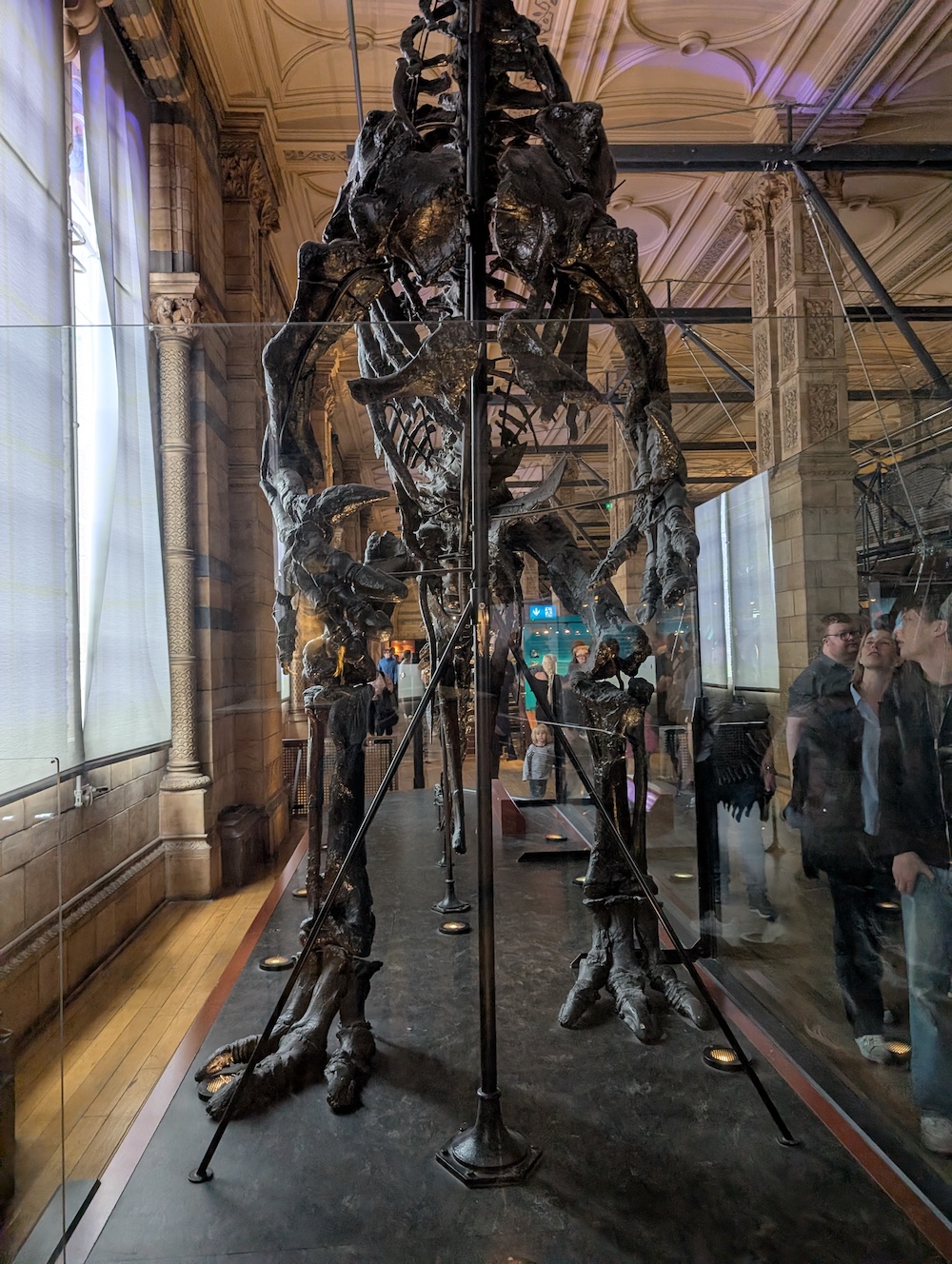
The explanation for Iguanodon's outdated posture is a fascinating story all its own. The museum was one of several institutions gifted a cast of a recently discovered skeleton, but the casts were allegedly made of large sections of the whole rather than of each individual bone; the skeleton thus cannot be repositioned and is doomed to present the now-superseded vision of a bipedal animal to visitors. The same discovery brought many other Iguanodon skeletons out of hiding, some of which were positioned for display; many of them are also frozen in their upright positions because they're too fragile to remount. That answers that, but, as is common with dinosaurs, there's some drama and intrigue to unpack as well. Iguanodon was originally a British discovery, with small fragments of bone and teeth being found first; the classic thumb claw was at one point thought to be a horn on its nose. These along with some other later discoveries were the beginning of the 'dinosaur' concept coined by Richard Owen, the same man who put on the Victorian dinner in the giant model Iguanodon and who played a substantial part in the creation of the Natural History Museum. But the museum's Iguanodon display is not British — the remains were discovered in Belgium, and they were much more complete and apt for study so became the new type specimen for the genus, and Iguanodon ceased to "be British", for all that's worth; and yet, for all that, the remains were still incorrectly positioned and cast in such a way as to make correction impossible. Richard Owen's claims about Iguanodon were many and mostly inaccurate but he was likely right to claim they walked on all fours; the display in "his" museum disagrees, likely incorrectly.
NHM's Iguanodon is a fascinating cultural artefact, but not of a dinosaur: it's an artefact of the concept of the exhibition of dinosaurs. It tells us much about how our understanding of dinosaurs has shifted wildly over time, and how that work is distributed across many countries whose workers are doing what they can with what they have, and how even an institution like NHM is very much reliant on whatever displays it's able to procure and present. I expect that they would rather position their dinosaurs correctly given the opportunity, but I think the display that's there now is far more compelling.
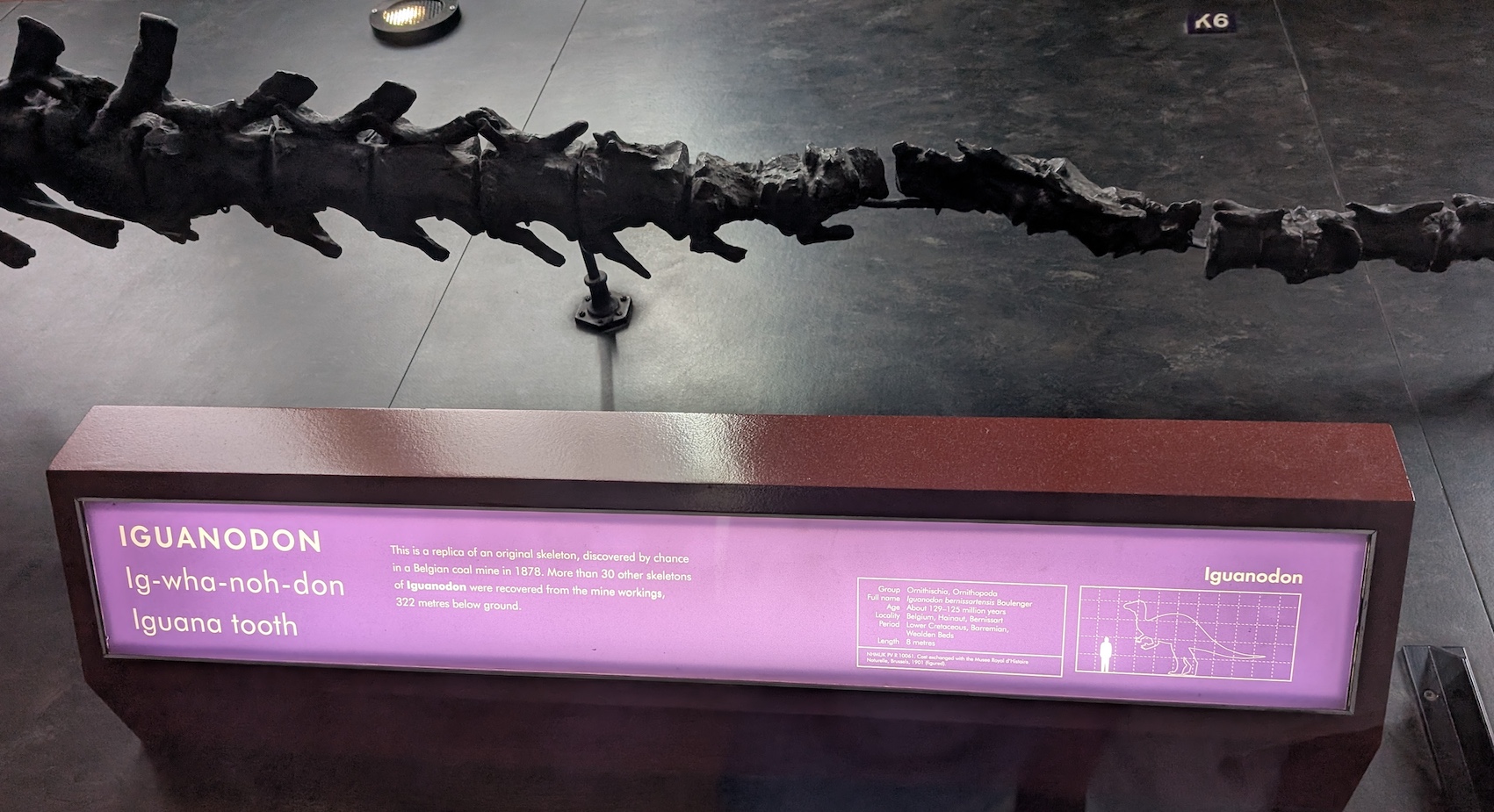
Alas, the NHM doesn't tell this story; it presents the skeleton as is, with a similarly poised outline for size comparison's sake, as though this is indeed what the animal was probably like. Alack, the maintainers of the gallery have good reasons not to burden the above descriptor panel with an essay such as this (or, perhaps, a less reductive version of it) and it is probably more helpful for general audiences to be inspired with the truths of dinosaurs rather than to be overloaded with the mistruths of museum exhibits. Every museum exhibit is ultimately a mistruth, but (in most cases at least) only in the way that any given physics model or grammar rule or moral principle is a mistruth; for the right dinosaur-loving nerd, the mistruth is one more layer of dinosaur complexity to pull back. Even NHM's Dinosaur Gallery, a place frozen in time (put a pin in that) that I've visited enough times to know very well indeed, is still an untapped source of fascination and fun once we're into the next layer. I love dinosaurs.